
From crafting a memorable first five minutes of class to evaluating wearable AI, the topics covered by 10 members of the Notre Dame Learning team across eight presentations at the 2026 Midwest Conference on the Scholarship of Teaching and Learning offered a window into the wide range of the organization’s pedagogical work.
Focused on the theme of “The Human Element of Education,” the conference took place April 10 at Indiana University South Bend. It was organized by a committee with representatives from two Indiana University campuses, two Purdue University campuses, and seven other colleges and universities. They included Notre Dame’s Amanda McKendree, Arthur F. and Mary J. O’Neil Director of the Fanning Center for Business Communication in the Mendoza College of Business.
Rice University’s Anne-Marie Womack, who had spoken at Notre Dame the day before as a guest of Notre Dame Learning’s Kaneb Center for Teaching Excellence, kicked off the conference with a keynote titled “Beyond Best Practice: Reimagining Disability & Access in Higher Education.”
The half-hour presentations by Notre Dame Learning faculty and staff from the Kaneb Center, Office of Digital Learning, and Teaching & Learning Technologies team—several of which were co-led by some of our collaborators from around campus—took place during the event’s concurrent sessions in the morning and afternoon.


Presentations
Click the + signs for details on the presentations. If you would like to learn more about these projects, please feel free to contact the presenters through their linked bios in the session descriptions.
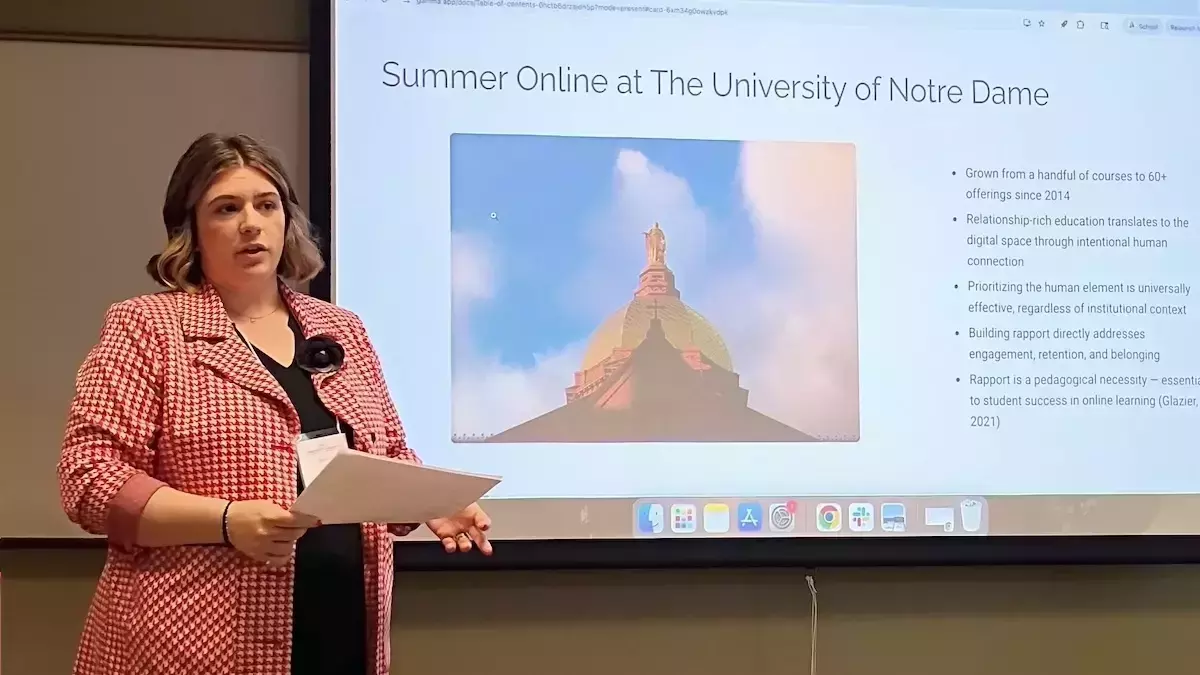
Building Rapport: Practical Strategies for Humanizing the Online Classroom
Brianna Stines (Office of Digital Learning)
Rapport-building is a pedagogical necessity for online course success. Drawing on Rebecca Glazier’s research and Stines’s expertise as a key member of the team behind Notre Dame’s successful Summer Online program, this session offered strategies to humanize syllabi, streamline personalized feedback, and practice proactive outreach. It moved beyond theory to help participants discuss and adapt these high-touch strategies for their own unique institutional contexts and varied student needs.
The First Five Minutes: A Catalyst to Content and Community
Melissa Scheve and Ashley Henry (Kaneb Center for Teaching Excellence)
The first five minutes of a class or session is an opportunity to pique curiosity, introduce content, and build community. In this session, participants experienced three opening activities from an Introduction to Teaching Excellence Series developed by Scheve and Henry and left with community openers to try with students or faculty.
Scream for Inclusion: Valuing Diverse Student Strengths via Horror Cinema
Elena Mangione-Lora (Department of Romance Languages and Literatures) and Steven Varela (Teaching & Learning Technologies)
Mangione-Lora and Varela discussed how Monstruos y Miedo: Terror, Power and Society in Latino and Latin American Film—a multilingual, project-based horror cinema course they co-teach—models inclusive design by building accessibility into its foundational pedagogy and applied social commentary. Employing film analysis, critical theory, immersive activities, and collaborative audiovisual production, it is a course that creates authentic inclusion that enhances learning for all students.
Evaluating Wearable AI at Notre Dame: Smart Glasses, Complex Questions
Steven Varela, Kael Kanczuzewski, and Crystal DeJaegher (Teaching & Learning Technologies); Elena Mangione-Lora (Department of Romance Languages and Literatures); Adam Heet (Hesburgh Libraries); and John Corba (Notre Dame Studios)
This presentation examined the impact of Ray-Ban Meta smart glasses on teaching and learning at Notre Dame through evaluation across accessibility, integrity, and privacy domains. While offering benefits like hands-free note-taking and real-time translation for students with disabilities, wearable AI presents tensions between technological capability and human-centered values, including around trust, authentic interaction, and equitable access, requiring guidelines prioritizing human dignity over innovation.
Human Connection Boosters
Brianna Stines (Office of Digital Learning)
Exploring the social and teaching presence elements of the Community of Inquiry (CoI) framework, Stines created a gamified workshop that challenged participants to solve a course design scenario in small teams.
Designing for Belonging: A Scalable Online Bridge Program to College
Kuangchen Hsu (Office of Digital Learning) and Brian Mulholland (Department of Mathematics)
Can online bridge programs foster genuine human connection? This session took up that question through the lens of ASCEND, a scalable online bridge program at Notre Dame implemented over multiple years to support both incoming student belonging and math readiness. Hsu and Mulholland, two of the principal collaborators in ASCEND’s development, shared concrete design strategies for building connection in digital spaces as well as a launch readiness checklist for planning similar programs.
VR, Neurodiversity & UDL: Creating Inclusive and Accessible Classrooms
Horane Diatta-Holgate (Kaneb Center for Teaching Excellence), Brent Fragnoli (Center for Student Support and Care), Matthew Simmons (Office of Digital Learning), and Ana María González Paniagua (Undergraduate Student)
The team behind a virtual reality project designed to immerse instructors and students in the experiences of neurodivergent learners discussed how small but intentional shifts in perspective and teaching practices—grounded in Universal Design for Learning (UDL) principles—can transform the classroom into an accessible and inclusive environment for everyone.
In addition to these seven presentations, the Office of Digital Learning’s Yi Lu gave a “Quick Hits” talk on “The Human Element in AI-Powered Design: Insights from Rapid Prototyping.”
About Notre Dame Learning
Notre Dame Learning houses the Kaneb Center for Teaching Excellence and the Office of Digital Learning, bringing together their teaching and learning expertise along with that of the OIT’s Teaching & Learning Technologies group to serve as the hub of learning excellence and innovation at Notre Dame. Working in collaboration with instructors, departments, and colleges, Notre Dame Learning’s goal is to enable effective and engaging learning for all students through research-based strategies and effective use of technologies across all modalities.