
When the 2025 Midwest Conference on the Scholarship of Teaching and Learning (SoTL) took place April 11, it was an outstanding opportunity for members of the Notre Dame Learning team and some of our campus collaborators to share the research and other work behind six different pedagogical projects.
Hosted at Indiana University South Bend, the conference was organized by a committee with representatives from two Indiana University campuses, two Purdue University campuses, and eight other colleges and universities. Among them were Notre Dame’s Amanda McKendree, Arthur F. and Mary J. O’Neil Director of the Fanning Center for Business Communication in the Mendoza College of Business, and Alex Ambrose, program director of assessment and analytics at Notre Dame Learning’s Kaneb Center for Teaching Excellence.
The event started in the morning with a keynote by Cate Denial, Bright Distinguished Professor of American History and director of the Bright Institute at Knox College. Denial previously gave the keynote at the Kaneb Center’s third annual Teach@ND Day in February.
The projects connected to Notre Dame Learning were highlighted during the afternoon—four as half-hour presentations and another two during a poster session.
Click the + signs for more on any of the projects.
Presentations
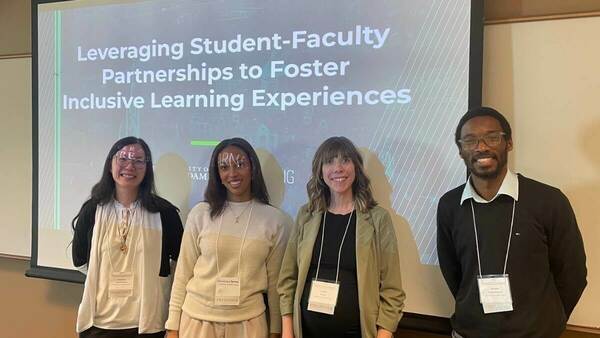
“Leveraging Student-Faculty Partnerships to Foster Inclusive Learning Experiences”
Jordyn Wilcox and Vanessa Chan-Devaere (Department of Psychology); Horane Diatta-Holgate (Kaneb Center for Teaching Excellence); Christalia Barone (Undergraduate Student)
In this session, two student-faculty pairs shared their unique insights on the process of creating an inclusive learning environment through a mutual student-faculty partnership program. Each pair outlined specific challenges faced, creative solutions developed, methods to measure outcomes, and the considerable benefits to both members of the partnership when the value of the student perspective is embraced.
“Using Exam Wrappers to Promote Student Metacognition in Introductory Biology”

Michelle Whaley, Alexis Waldschmidt, Kristin Lewis, Benjamin Rudenga, and Dominic Chaloner (Department of Biological Sciences); Walton Ferguson (Department of Psychology); Kathy Quardokus Fisher and Alex Ambrose (Kaneb Center for Teaching Excellence); Kevin Abbott (Teaching & Learning Technologies)
Notre Dame’s Introductory Biology course uses a structured learning cycle and passage problem exams. This presentation shared data on exam wrappers, a metacognitive tool to encourage students to reflect on their learning strategies and exam performance, and to make a plan for future study. The team hypothesizes that exam wrappers will be particularly valuable for underprepared students and, through this reflective assignment, hopes students will adopt new strategies to enhance their learning and performance.
“It’s ECE: Engaging Experiential Cultural Education Through Immersive Flamenco Escape Room”
Tatiana Botero and Elena Mangione-Lora (Department of Romance Languages and Literatures)
A collaboration with Notre Dame Learning’s Office of Digital Learning led to a virtual flamenco-themed escape room designed to engage students with authentic cultural materials through immersive technology. By integrating established pedagogical best practices, the tool fosters creativity, collaboration, and critical thinking while introducing sophisticated cultural concepts. The project demonstrates how technology, when thoughtfully implemented, can make cultural education accessible, interactive, and engaging.

“The Virtual Borders Project: What Do We Owe Each Other?”
Steve Varela (Teaching & Learning Technologies)
The stories of Latin American and Mexican migrants are frequently overshadowed by political rhetoric, resulting in a one-dimensional portrayal that lacks the depth and humanity of the migrant experience. This often leads to a misunderstanding of their challenges and contributions to society. The Virtual Borders Project works to communicate these experiences authentically and compellingly through extended reality (XR).
Posters

“Student Perspectives on Generative AI: Usage, Ethics, and Institutional Support in the Humanities”
Xiuxiu Tang and Ying Cheng (Department of Psychology); Elena Mangione-Lora (Department of Romance Languages and Literatures); Alex Ambrose (Kaneb Center for Teaching Excellence); Nathaniel Myers (University Writing Program); Si Chen (Notre Dame Learning and Lucy Family Institute for Data & Society); Judy Lee and Isabella Correa Martinelli (Undergraduate Students)
Presenters shared a study that investigates college students’ perceptions, adoption, and ethical concerns regarding generative AI through a structured survey. Providing evidence-based insights into AI’s impact on student learning, particularly in writing, language, and literature, the study’s findings will guide institutional policies on AI literacy, academic integrity, and student support.
“Empowering Instructors with AI: Human-Centered Design of a Teaching Chatbot”
Izzy Molnar and Adam Acunin (Undergraduate Students); Si Chen (Notre Dame Learning and Lucy Family Institute for Data & Society); Reid Metoyer, Khiem Le, Nitesh Chawla, and Ronald Metoyer (Department of Computer Science and Engineering); Alex Ambrose and James Lang (Kaneb Center for Teaching Excellence)
This poster presented the development of an AI-powered teaching chatbot designed to provide context-aware teaching suggestions for instructors. Rooted in human-centered design and faculty research, the chatbot enhances pedagogy through trustworthy, adaptive, and ethical AI interactions. Findings reveal insights into instructor attitudes toward AI and the need for transparent, discipline-specific, and customizable AI support in teaching.
About Notre Dame Learning
Notre Dame Learning houses the Kaneb Center for Teaching Excellence and the Office of Digital Learning, bringing together their teaching and learning expertise along with that of the OIT’s Teaching & Learning Technologies group to serve as the hub of learning excellence and innovation at Notre Dame. Working in collaboration with instructors, departments, and colleges, Notre Dame Learning’s goal is to enable effective and engaging learning for all students through research-based strategies and effective use of technologies across all modalities.