Assessment |
Implementation Guide for Two-Stage Exams
Table of Contents
What are Two-Stage Exams? Why Give Them?
How to Implement Two-Stage Exams
References and Further Reading
What are Two-Stage Exams? Why Give Them?
Two-stage exams (also known as collaborative exams) are an assessment strategy in which students complete an exam twice: first individually, and immediately afterward in small groups. By coupling these two stages, this approach transforms a tool for individual assessment into a tool that can also itself be a formative learning experience (Efu, 2018).
Benefits of two-stage exams include that they:
- Provide helpful immediate feedback
- Explicitly incentivize communication and collaboration
- Introduce social pressure to study
- Improve content understanding
- Improve long-term learning
For more on these benefits and how two-stage exams can work in classes of any size, check out this episode of Notre Dame Learning’s Designed for Learning podcast:
How to Implement Two-Stage Exams
The basic two-stage exam protocol is administered during a single, combined exam period, typically lasting 75 minutes. The assessment is split into two distinct parts: an individual attempt followed immediately by a collaborative group attempt.
During the first portion, lasting around 50 minutes, students complete the exam individually, just like a traditional exam. After the individual answer sheets are collected, students spend the remaining time retaking the exact same exam in a group, benefiting from collaborative discussion and peer input. In this way, each student submits their own individual answer sheet and their own group answer sheet.
A student’s final score for the assessment is calculated as a weighted average. The individual score accounts for the majority (say, 80 percent) of the total exam grade, with the group score contributing the remaining 20 percent.
While this assessment method may seem logistically challenging at first, successful execution in large-enrollment classrooms is entirely manageable with planning.
- At the Beginning of the Semester
- Organizing and Communicating the Seating Plan
- Exam Design and Preparation
- Exam Administration: Setup and Execution
- Post-Exam and Assessment
At the Beginning of the Semester
On the first day of class, introduce the concept of two-stage exams. Students will benefit from:
- Clarity regarding how the exams will contribute to how they are assessed in the course so that they fully understand what their exam experience is going to be like and how their grade will be calculated.
- An explicit rationale for the group component, which reinforces expectations and outlines the demonstrated benefits. The syllabus and first-day discussion should include this rationale.
- A commitment on your part to building a culture of trust and collaboration in the classroom. Any classroom practices or activities that increase the ability of students to get to know each other and work together will improve their exam experience when it’s time to rely on their groupmates.
Bottom Line for Instructors
Include explicit language describing the “why” and “how” of two-stage exams in both the syllabus and on the first day of class. Consider how to increase student collaboration throughout the semester, including giving them time to introduce themselves to the people around them or engage in active learning activities in which they work together on class problems.
Organizing and Communicating the Seating Plan
Planning the Groups
In the days immediately preceding the exam, the total number of required groups is calculated by dividing the class roster by three, after removing students who have a scheduled make-up exam or take the exam at an accommodations center. The remaining students are then randomly sorted into groups. This process is easily managed using spreadsheet software like Excel or Google Sheets:
- Assign each student a random number using the built-in RAND function.
- Sort the entire roster in ascending order based on that random number.
- Assign groups sequentially down the sorted list (e.g., the first three students become Group 1, the second three students become Group 2, etc.).
Create a seating map
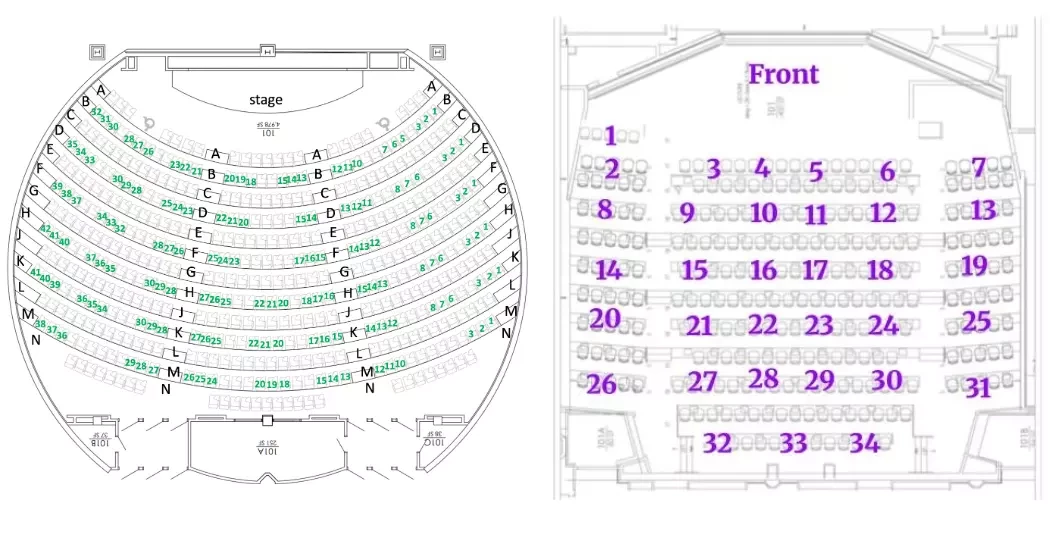
Create a seating map for the exam room that includes marked locations for each assigned group or seat numbers (if applicable in your testing room). When designing the plan, incorporate a few empty rows in large rooms to ensure instructional staff can move easily among students.
In the example of a large room on the left of Figure 1, each seat is labeled on the chair itself. To make it easier for the students to know where to find their seat, the map highlights the seats in which students are assigned. In the room on the right, seats are not labeled and chairs can move freely. To account for this, students can be sent their assigned group number and the map so that they could anticipate where in the room their group would be seated.
Communicate with Students
To ensure students know where to go on exam day, send a personalized email one or two days beforehand. Personalized emails can be generated using mail-merge software like Yet Another Mail Merge. This communication should contain essential information for the student to arrive prepared:
- Their specific group number
- Their assigned seat number (if applicable)
- A copy of the exam room map
Bottom Line for Instructors
Use a map of the exam room, spreadsheet tools, and mail-merge software to organize and communicate the seating plan for exam day.
Exam Design and Preparation
All standard exam preparation—writing, editing, uploading to grading software, and building the rubric—should proceed as usual. However, instructors should strategically shift the balance of question types to align with the two-stage format.
Question Design and Balance
If possible, instructors should shift the exam to be mostly difficult, analysis-driven multiple-choice, multiple-multiple-choice, or short-answer questions. This preference serves two practical benefits:
- Multiple-choice questions are quicker to grade, helping to offset the increased grading burden.
- Student feedback indicates that open-ended questions are the most difficult to collaborate on in the compressed group timeframe.
Plan How to Most Easily Grade Individual and Group Exams
When each student submits one individual answer sheet and one group answer sheet, it is easiest to make the individual exam and the group exam as separate assignments within the grading software and LMS. The weighting of the grades between the individual and group assignments is most easily accomplished by adjusting the number of points that each assignment is worth. In this way, the total exam score can be easily calculated by adding the individual and group exam score for each student. This can also be accomplished within an LMS by putting the individual and group exam score in an “assignment group” by themselves.
To weight the individual and group portions of the exams appropriately, adjust the point values to achieve the desired weighted split (e.g., 80 percent individual/20 percent group). For arithmetic convenience, select a split where each rubric item on the individual exam can be divided by a whole number to determine the points for the corresponding group item. For example, for an 80/20 split, every rubric item on the individual portion is simply divided by a factor of four to yield the group points.
Grading software, such as Gradescope, can greatly assist with this process.
Supply Checklist
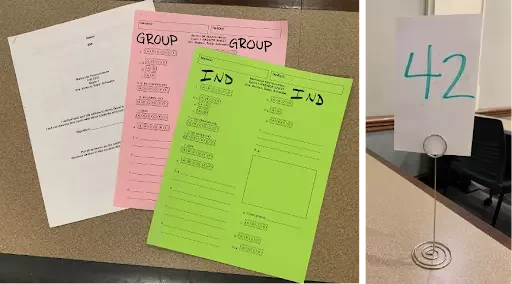
Three documents must be printed for each student: the exam question booklet, the individual exam answer sheet, and the group exam answer sheet. The two answer sheets should be identical, except for two key features:
- They are printed on different colored paper.
- They are clearly labeled at the top with either “INDIVIDUAL” or “GROUP.”
Using colored paper is a logistical aid that makes it much easier for instructional staff to visually confirm that all individual answer sheets have been collected before the group portion begins.
Note that during the group stage, each student still turns in their own answer sheet based on the group’s work.
If the exam room lacks fixed seat numbers, use restaurant-style table number holders and numbered notecards to clearly indicate group locations.
Bottom Line for Instructors
Design the exam to consist mostly of difficult multiple-choice questions. Adjust the assignment rubric for the individual and group exams to reflect the desired weighting, and set up these assignments in your grading software and LMS. Print the three exam documents (question booklet, individual answer sheet, group answer sheet) on different-colored paper. Make sure you have a way for students to be able to quickly identify where they should sit if it’s not already built into the exam room.
Exam Administration: Setup and Execution
Before students are permitted to enter the room, the instructional staff must set up the exam environment. For a class of approximately 250 students, this process requires four staff members and takes about 20 minutes to complete.
Room Setup
Pre-stage the documents at the desks to eliminate the distribution bottleneck. Key setup steps include:
- Placing group number markers (e.g., table number holders) at the predetermined locations if the room lacks fixed seating.
- Laying out the three required exam documents (question booklet, individual answer sheet, group answer sheet) at every designated student spot.
- Projecting slides onto the screens displaying the exam instructions, the seating map, and a table of student names/group numbers for quick reference.
Students should be given flexibility to move within their designated group's area, accommodating issues like broken desks or a preference for more personal space.
Execution
The individual portion of the assessment runs for the first 50 minutes, adhering to a traditional exam format. At the 50-minute mark, the individual answer sheets are collected by instructors, a process dramatically simplified by the use of colored paper.
Once collection is complete, the class is instructed to begin the group portion of the exam, and permission is explicitly granted for students to talk freely with their assigned group members. Students then use the remaining 25 minutes to collaboratively complete and submit their group answer sheet. All remaining exam documents are collected at the end of the total exam period.
Bottom Line for Instructors
Have slides ready that show exam instructions, a seating map, and a table of student names and seat numbers. Have your exam supplies ready to go. Get to the exam room early and set out the three exam documents on the desks where students will sit. During the exam itself, have a plan for quickly collecting individual answer sheets and for announcing the transition to the group part of the exam in which students are allowed to talk freely.
Post-Exam and Assessment
Grading Strategy
Using a grading software like Gradescope can greatly increase the speed and ease of grading.
Grade the individual exams first, as this allows graders to refine the rubric with real student responses. Once the individual exams are complete, the group exams can be graded much faster, typically taking only about one-third the time, due to fewer mistakes and the graders’ familiarity with the acceptable responses.
Feedback and Refinement
Following the exam, the final step involves releasing the grades and conducting the standard exam review. It is highly recommended to solicit explicit feedback from students specifically about the two-stage exam protocol. This direct feedback is invaluable for refining the process to the unique needs of the course and optimizing logistics for the students.
Bottom Line for Instructors
Use grading software such as Gradescope to speed grading. Grade individual exams first, then group exams. Solicit student feedback about the two-stage exam process.
Frequently Asked Questions
Group Dynamics
How do I ensure cooperation between groups?
The most effective way to manage within-group conflict is to have each student fill out their own answer sheet during the collaborative portion of the exam (remember everyone has their own even during this group stage). This policy allows students to record their preferred answer when a consensus cannot be reached, effectively de-escalating disagreements. Well-prepared students enjoy the opportunity to demonstrate and justify their knowledge, and the knowledge of impending collaboration increases their motivation to study.
Should groups be random?
Using a random number generator for group assignment is vastly less time-consuming for large-enrollment courses. While some evidence suggests a mix of preparedness levels is optimal, obtaining that data before the first exam is impractical. The random method still creates a sufficient mix of students on average, and students appreciate the random nature of the groups, which avoids perceived bias.
Should the groups be different for every exam?
In the absence of significant in-class group projects in which students get to know and trust a specific group of peers, randomizing the group for every exam is the superior strategy. This approach protects against potentially detrimental “bad mix” groups and actively provides incentives for a classroom culture of mutual trust and helpfulness.
How big should the groups be?
Groups of three or four are considered the optimal size for two-stage exams. In larger groups, students are often unable to contribute equally, compromising the collaborative objective. A group of three or four also provides a buffer against emergencies; if one student is absent, the remaining members can still proceed effectively.
Exam Design and Logistics
Does the group exam have to be exactly the same as the individual exam?
No, it does not. Keeping the exams identical provides organizational simplicity, as the same answer sheet and rubric can be directly applied to both portions. Some instructors use only a subset of questions from the individual exam for the group assessment, typically targeting the most difficult problems.
Does the testing period have to be 75 minutes?
The 75-minute testing period (50 minutes individual/25 minutes group) is a practical and well-received balance, though it is not mandatory. Students strongly prefer the individual portion be no shorter than 50 minutes because they require sufficient time to think through and answer each question. The collaborative portion naturally moves much more quickly than the individual attempt.
What if a student performs worse on the group portion?
This protocol allows the group exam grade to theoretically lower the overall weighted score, if the group grade is worse than the individual grade. This rule, coupled with each student submitting their own group answer sheet, is fair because it assigns a consequence if a student is easily convinced away from a correct initial answer, thereby incentivizing confidence and critical justification of their choices.
Instructor Load and Coordination
How do I account for the increase in grading time?
The total number of items to grade is effectively doubled, but this can be managed by shifting the exam toward multiple-choice questions and completing all grading using software like Gradescope. Overall, this approach minimizes the impact of the increased grading burden on grading speed.
How would the exam change if there are multiple sections of the course?
If a multi-section course uses a single common exam, the two-stage protocol remains largely unchanged. Instructors must decide whether they want groups to be composed only of students within the same section or if they prefer to mix them freely. Both methods are acceptable and can be managed by adding the section number as a column in the organizational spreadsheet.
Student Access and Accommodations
How do I account for students who take the exam at an accommodations center?
If the accommodations center cannot facilitate the two-stage exam protocol (usually due to either logistical or privacy concerns), students with testing accommodations take only the individual portion of the exam. To ensure grade equity in such cases, the class average group exam score is applied to their “group”' portion of the test. For these students, their individual grade is set as the floor of their total exam grade, ensuring their score cannot decrease as a result of the artificially assigned group. This protocol ensures accommodated students receive a comparable grade bump, though feedback indicates that students perceive this protocol as fair. However, this does mean that students who take the exam at an accommodations center do not have the chance to get immediate feedback on the exam in the same way as students without accommodations.
Other strategies are to have the students take the individual exam at an accommodations center then join for the group portion with the rest of the class, or to separately proctor the two-stage exam for students with accommodations.
How do I meet the needs of students with physical disabilities?
In the syllabus and on the first day of class, suggest students message you privately if they might benefit from sitting in a particular part of the room due to a physical disability. For example, some students have trouble navigating stairs or need to sit closer to the front due to vision issues. Note these students in your organizational spreadsheet to make sure their seating assignments are suited to their needs. This also normalizes and standardizes the process of requesting such accommodations for students who may have needs that arise during the course of the semester.
Grade Inflation
How do I account for the increase in student grades as a result of the group portion of the exam?
The two-stage exam protocol leads to a small increase in student exam scores. The average grade on the group portion is ~10 percent higher than the average individual grade. Thus when using an 80/20 split, a student’s total exam score would be on average 2.5 percent higher than on a traditionally administered exam. Instructors have a few options to mitigate this increase:
- Write a more challenging exam.
- Change the weighting balance (e.g., shifting from an 80/20 to a 90/10 split).
- Adjust the overall course grading schema to account for the expected bump.
Despite this predictable increase in exam averages, data indicates that using a two-stage exam does not significantly alter the distribution of letter grades for the exam. Thus, a two-stage exam is still an effective way to assess individual student performance.
References and Further Reading
Bloom, D. (2009). Collaborative Test Taking: Benefits for Learning and Retention. College Teaching, 57(4), 216–220.
Bruno, B. C., Engels, J., Ito, G., Gillis-Davis, J., Dulai, H., Carter, G., Fletcher, C., & Böttjer-Wilson, D. (2017). Two-Stage Exams: A Powerful Tool for Reducing the Achievement Gap in Undergraduate Oceanography and Geology Classes. Oceanography, 30(2).
Cooke, J. E., Weir, L., & Clarkston, B. (2019). Retention following Two-Stage Collaborative Exams Depends on Timing and Student Performance. CBE—Life Sciences Education, 18(2).
Creating Assessments with Individual and Collaborative Components | Instructional Moves. (n.d.). Retrieved October 20, 2025, from https://instructionalmoves.gse.harvard.edu/using-two-stage-exams-facilitate-learning-during-assessment
Efu, S. I. (2018). Exams as Learning Tools: A Comparison of Traditional and Collaborative Assessment in Higher Education. College Teaching, 67(1), 73–83.
Evangelista, E. D. L. (2025). Ensuring academic integrity in the age of ChatGPT: Rethinking exam design, assessment strategies, and ethical AI policies in higher education. Contemporary Educational Technology, 17(1), ep559.
Heller, P., & Hollabaugh, M. (1992). Teaching problem solving through cooperative grouping. Part 2: Designing problems and structuring groups. American Journal of Physics, 60(7), 637–644.
Newton, G., Rajakaruna, R., Kulak, V., Albabish, W., Gilley, B. H., & Ritchie, K. (2019). Two-Stage (Collaborative) Testing in Science Teaching: Does It Improve Grades on Short-Answer Questions and Retention of Material? Journal of College Science Teaching, 2019, Taylor & Francis, 48(4), 64–73.
Rao, S. P., Collins, H. L., & DiCarlo, S. E. (2002). Collaborative testing enhances student learning. Advances in Physiology Education, 26(1–4), 37–41.
Rieger, G. W., & Heiner, C. E. (2014). Examinations That Support Collaborative Learning: The Students’ Perspective. Journal of College Science Teaching, 43(4), 41–47.
Slusser, S. R., & Erickson, R. J. (2006). Group Quizzes: An Extension of the Collaborative Learning Process. Teaching Sociology, 34(3), 249–262.
Stearns, S. A. (1996). Collaborative Exams as Learning Tools. College Teaching, 44(3), 111–112.
Wieman, C. E., Rieger, G. W., & Heiner, C. E. (2014). Physics Exams that Promote Collaborative Learning. The Physics Teacher, 52(1), 51–53.
Zimbardo, P. G., Butler, L. D., & Wolfe, V. A. (2003). Cooperative College Examinations: More Gain, Less Pain When Students Share Information and Grades. Journal of Experimental Education, 71(2), 101–125.
Zipp, J. F. (2007). Learning by Exams: The Impact of Two-Stage Cooperative Tests. Teaching Sociology, 35(1), 62–76.