Examples of AI in Teaching at Notre Dame
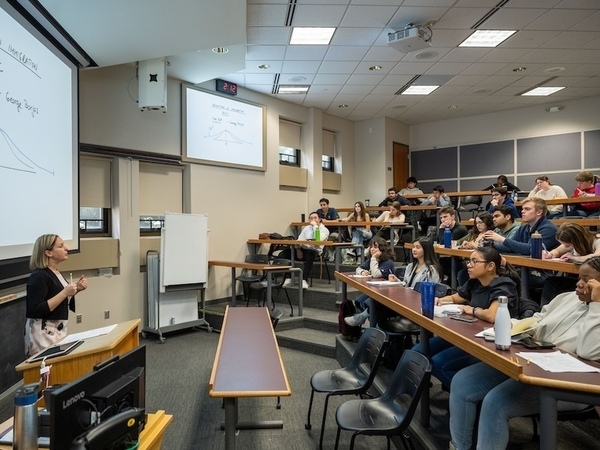
As a Notre Dame instructor, you are likely thinking about how to adapt your course for AI—whether that means integrating it into what you ask students to do or developing assignments and assessments that are resilient in light of AI’s capabilities. And of course, you may be doing both, looking to bring AI into your teaching in some cases while restricting its use in others.
To support you in this work, our Lab for AI in Teaching in Learning, with support from the Hesburgh Libraries’ CurateND platform, is pleased to host this repository of assignments and other materials that have been developed by Notre Dame faculty exploring what AI means in the context of their teaching. You can check it out via the button here or expand the Background tab for more information, including how to contribute.
*Please note: You have to be logged in with your Notre Dame NetID to view the repository. If you plan to copy/paste the text of one of the materials contained therein, please cite the original in a manner appropriate to your discipline.
Background
What Is It?
In the repository, you’ll find short, practice-oriented resources created by Notre Dame instructors for use in classes at the University. We thank these colleagues for generously sharing their work with us so that we can all learn from their ideas.
This project is in its early stages, and we expect to grow the number of resources over time.
How to Contribute
If you’re a Notre Dame instructor and would like to contribute to this repository, please use this form. Items we’re looking for include syllabus AI policies, AI-resilient assignments, AI-augmented assignments, brief descriptions of classroom activities, and infographics highlighting effective practices.
The Decisions are Yours
As always, the goal is not to tell you how to use AI in your classes—or to use it in your teaching at all—but we do want you to continue to talk with your students about AI. They value your opinion, and we know that faculty engaging thoughtfully about AI’s promise and its perils will be critical to our students’ future success.
Sample Repository Materials
Small Class Size
Medium Class Size
Large Class Size
Start with the Syllabus: Articulating and Implementing Clear AI Policies
Course Title: Global Struggles For Freedom
Course Number: CSEM 23101-25 (14668)
Class Size: Small
Faculty Name: Victoria Tin-bor Hui (Department of Political Science, University of Notre Dame)
From Professor Hui:
“When I designed Global Struggles for Freedom, my goal was not only to help students understand why people risk everything to fight for liberty but also to prepare them for a world where AI tools are pervasive. The course syllabus explicitly lays out how, when, and why AI can be used. Students need clarity and ethical guardrails, not ambiguity. I make it clear that representing work generated or modified by AI as one’s own is academic dishonesty and a violation of the University Honor Code.
“At the same time, I want students to see AI as a thought partner. I encourage them to use Praxis Pria, Notre Dame’s AI pilot tool, for factual checks—the “who, what, when, where” of global freedom struggles—but only after drafting their own work. They must verify all outputs and reflect on how AI’s limitations sharpen their own judgment. Every AI interaction must be transparently cited using MLA-style attribution.”
Incorporating AI Into an In-Class Peer Instruction Polling Activity
Course Title: Physical Chemistry I
Course Number: CHEM 30321
Class Size: Medium
Faculty Name: Hsing-Ta Chen (Department of Chemistry & Biochemistry, University of Notre Dame)
From Professor Chen:
“While in-class peer instruction has proven an effective approach for increasing student engagement and understanding in active learning settings, its effectiveness depends on students’ prior knowledge. Especially for physical chemistry, successful peer instruction requires students’ mathematical intuition to link equations with physical phenomena. To help with this, I have integrated AI learning tools as students’ learning partners in the in-class peer-instruction activity.”
AI-Powered Coding Practice System
Course Title: Foundations of Coding
Course Number: ITAO 20210
Class Size: Large
Faculty Names: Fred Nwanganga, Xiaojing Duan (Department of Information Technology, Analytics, and Operations, University of Notre Dame)
From Professors Nwanganga and Duan:
“Like many instructors teaching introductory programming courses, we wanted to give students significantly more opportunities to practice coding, yet found it difficult to provide individualized, high-quality feedback outside class. To address this, we developed an AI-powered practice system that delivers ungraded, formative exercises aligned with specific learning objectives.”